the historic and charming village of Nemi
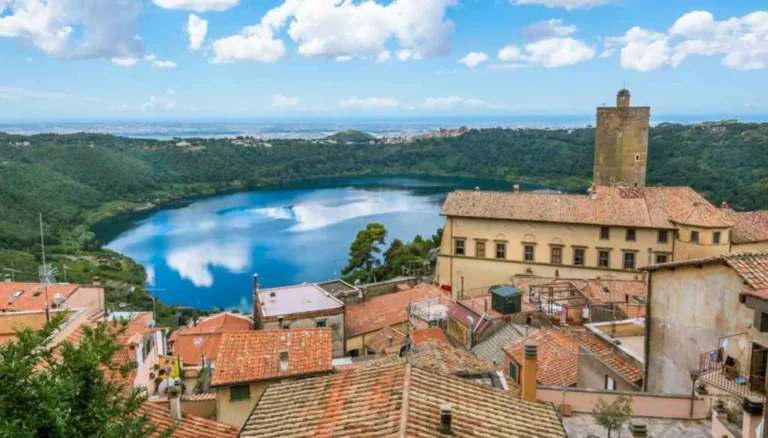
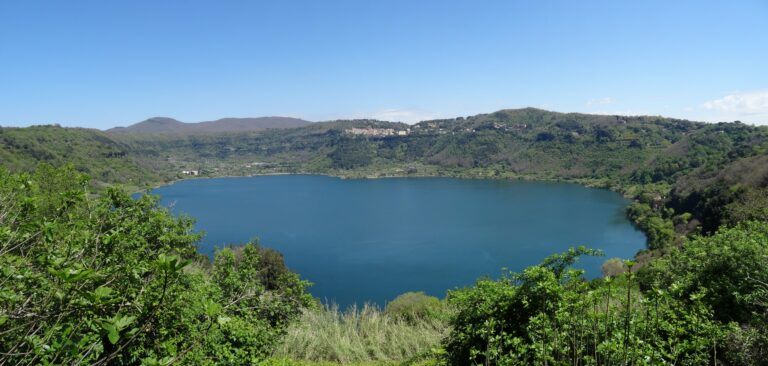
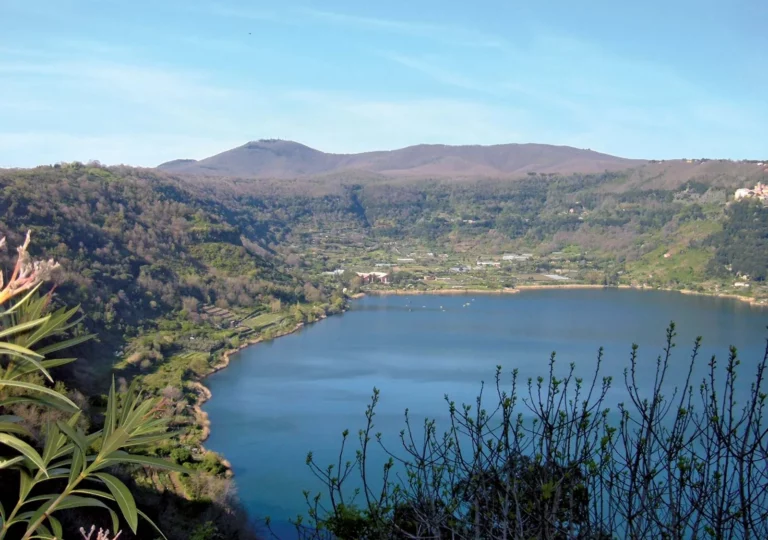
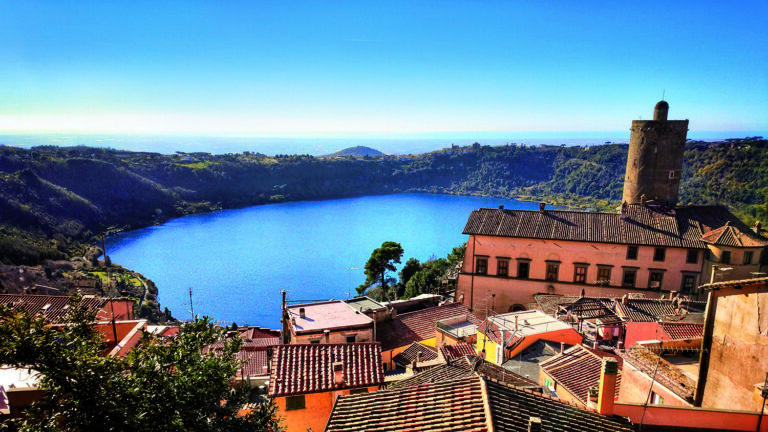
THE GEOGRAPHICAL AND NATURAL FRAMEWORK
The physical context of the Alban Hills
Nemi is located in the heart of the Alban Hills, an ancient volcanic complex that shaped the geography of the area southeast of Rome. This volcanic apparatus, also known as Vulcano Laziale, was active for hundreds of thousands of years and bequeathed craters, secondary cones, volcanic lakes, and extremely fertile soils. Lake Nemi is one such crater basin, formed as a result of calderic collapse and accumulation of meteoric waters. In contrast to the larger Lake Albano (Castel Gandolfo), Nemi is smaller, intimate and cozy, with an almost elliptical shape that recalls the image of a blue-green “mirror” set between high wooded walls.
The altitude of the village (over 520 meters above sea level) and the sharp drop from the lake create a special microclimate: in summer, breezes keep the air cooler than on the Roman plain, while in winter the mists from the lake give the landscape an almost fairy-tale appearance. These climatic conditions have favored the growth of lush forests and the cultivation of valuable plants since ancient times. Even today the volcanic soil is still exploited for agricultural production, particularly strawberries and flowers.
The lake: measurements and peculiarities
Lake Nemi has an area of about 1.67 km², an average depth of 19 meters and a maximum depth of about 30 meters. The perimeter is around 5 km. It has no major natural tributaries, and its waters are fed mainly by rainfall and underground aquifers. The absence of natural outlets has made it necessary, since the Roman age, to open drainage tunnels (artificial outfalls) to regulate the water level: Roman hydraulic engineering, always attentive to these balances, built outflow tunnels that still constitute an interesting technical document.
The shores of the lake, covered with chestnut, holm oak and oak forests, were perceived as sacred places even in ancient times. The silence and dense vegetation have over the centuries nurtured the sense of mystery and “separation from the world” that characterizes Nemi compared to other nearby towns.
THE NAME AND RELIGIOUS SIGNIFICANCE
The etymology of “Nemi”
The name “Nemi” comes from the Latin nemus, meaning “forest,” “sacred clearing.” In antiquity the term did not denote a simple forest, but rather a consecrated area protected by religious prohibitions and laws (the so-called ius nemoris). The Romans distinguished between lucus (natural sacred forest) and nemus (ordered sacred forest, often connected to a specific cult).
The Nemus Dianae was thus the forest consecrated to Diana, goddess of hunting, wilderness, and the moon. According to sources (Ovid, Strabo, Cicero), this place was not only a local shrine, but a landmark for the entire Latin League. The appellation Diana Nemorensis (Diana “of Nemus”) became part of Roman religious culture and remained in use over the centuries, so much so that it generated the modern toponym.
Diana Nemorensis: a federal cult
The cult of Diana in Ariccia and Nemi is one of the most fascinating in ancient Latium. Diana, an Italic and Latin goddess before Roman, had a shrine here that served as a meeting place for Latin cities. Every year, on August 13, a great feast was celebrated in honor of the goddess: the federated communities offered sacrifices and gifts, renewing the political and religious ties of the Latin League.
Pliny the Elder and Propertius recall the sanctuary’s fame; Cicero mentions it as a place “most ancient and revered.” Augustus himself, in the imperial age, emphasized its prestige, linking it to the system of official cults.
The presence of a federal cult and the extraordinary archaeological wealth confirm that Nemi was never just a village, but a symbolic center of interregional importance.
THE SHRINE OF DIANA
Architectural structures
Archaeological excavations, which began systematically in the late 19th century and continued in several phases in the 20th century, have unearthed imposing terraced structures with large niche walls, steps, porticoes, and rooms used for cultic functions. Monumentalization occurs between the 2nd and 1st centuries B.C.E., paralleling the Roman tendency to transform local sanctuaries into scenic complexes.
The niches facing the lake, now partly visible, formed a kind of architectural setting in which statues and altars enriched the experience of the faithful. The scheme is reminiscent of other shrines in Latium (e.g., that of Hercules the Victor at Tivoli), but at Nemi the symbiosis with the surrounding nature is even more evident.
The Rex Nemorensis
One of the most enigmatic aspects of the cult is the figure of the Rex Nemorensis, the “King of the Wood.” According to the account of Strabo and, later, Suetonius, the priestly office was not transmitted by inheritance or appointment, but conquered in a duel: the runaway slave who managed to break off a sacred branch and kill the incumbent priest became the guardian of the cult himself. This bloody and unique rite in Roman religion has impressed modern scholars, so much so that James Frazer made it famous in The Golden Bough (1890), one of the most influential works of religious anthropology.
The modern interpretation emphasizes that Rex Nemorensis symbolized the vitality of nature: power, constantly challenged, was always exposed to struggle and death, like the cycle of the seasons.
THE SHIPS OF NEMI: CALIGULA, THE FIND AND THE TRAGEDY OF 1944
Imperial boats in the lake
One of the aspects that has made Nemi famous throughout the world is the affair of the so-called Ships of Caligula. These are two gigantic vessels discovered at the bottom of the lake, extraordinary both in size and architectural complexity. The attribution to Emperor Caligula (37-41 AD) is based on bronze inscriptions found on board, bearing the name Gaius Caesar Augustus Germanicus, the prince’s official title.
The ships, about 73 and 67 meters long and more than 20 meters wide respectively, had colossal tonnage. The first was probably intended for cultic functions, perhaps as a floating temple dedicated to Diana or other deities; the second may have functioned as a residence or ceremonial hall. These were not ships for navigation at sea, but stable platforms adorned with marble, columns, mosaics, and statues. Some technical elements reveal a highly advanced level of engineering: bronze anchors, multiple rudders, ball suspension systems for pivots, mosaic-decorated floors, and lead piping for water distribution.
International scholars (e.g., the British archaeologist John S. Morrison, a specialist in naval archaeology, and the Italian Ugo Monneret de Villard, who studied the finds between the two wars) have pointed out that these ships were an absolute unicum in the Roman scene: they were not mere means of transportation, but real floating palaces.
The religious and political significance
There are many hypotheses about the use of the ships. Some scholars in the past have interpreted them as “floating villas” where Caligula, known for his excesses, allegedly held banquets and parties. However, more recent research (including that published in the 2000s by Mary Beard and Andrew Wilson) points out that it is more likely that the ships had a cultic function. The presence of altars, statues, and sacred decorations suggests spaces intended for ceremonies, perhaps related either to Diana Nemorensis or to the Eastern cult of Isis, much in vogue in Rome in the imperial age.
The connection with Isis is not coincidental: some iconographic elements found among the artifacts (e.g., decorations with Egyptian symbols) recall the Isiac religion, which included aquatic rituals and processions on sacred vessels. Caligula himself was fascinated by Eastern cults and could have commissioned the ships as instruments of representing imperial and religious power together.
Early recovery efforts
The ships of Nemi had been known since the Renaissance. In 1446, Cardinal Prospero Colonna organized a salvage attempt using huge hooks and chains: he succeeded in extracting some planks and wooden fragments, but irreparably damaged part of the submerged structures. In 1535, Francesco De’ Marchi, military engineer to Pope Paul III, personally dived with a rudimentary diving suit, describing in his diaries the magnificence of the ships. Leon Battista Alberti and other Renaissance scholars also showed interest, but technology did not yet allow for complete recovery.
In the 17th and 18th centuries there were further partial attempts, always failed or aborted due to the complexity of the operation. Meanwhile, bronze and wood fragments occasionally found enriched private and museum collections.
Recovery in the fascist era (1929-1932)
The big step came during the regime of Benito Mussolini, who wanted to make the recovery of the ships a symbolic undertaking of the rebirth of imperial Rome. A colossal engineering project was carried out between 1929 and 1932: the lake level was lowered by about 20 meters by reactivating and widening the ancient Roman outfall, which was more than 1,600 meters long.
The operation, directed by engineer Guido Ucelli and closely followed by the international press, made it possible to bring both vessels to light, and they were placed in a specially built museum on the shores of the lake: the Museum of Roman Ships in Nemi, which opened in 1936. The feat was celebrated as a technological and propagandistic victory, combining archaeological pride with fascist rhetoric of a “return to imperial greatness.”
Photographs and newsreels of the time document the collective excitement and cultural impact of the event. The ships were the subject of studies, surveys, and early graphic reconstructions that enabled an appreciation of their complexity.
The destruction of 1944
On May 31, 1944, during World War II, the Roman Ship Museum was devastated by a fire that almost completely destroyed the two boats. Responsibility has never been fully clarified: some sources blamed retreating German soldiers, others speculated artillery hits or even accidental accidents. Whatever the truth, the loss was immense and irreparable.
Today only a few bronzes, minor artifacts and the photographs and drawings made in the 1930s remain. Among the surviving pieces are lion heads, decorative protomes, parts of columns and fragments of mosaics, which are now kept in the same museum, which has been reopened to the public with a modern and educational layout. Instead of the original ships, partial reconstructions and scale models are displayed, enabling visitors to understand the exceptional nature of the feat.
Ships in the collective memory
The story of the Nemi Ships has taken on almost mythical value. On the one hand, they represent an extraordinary example of Roman engineering and imperial ceremonial culture; on the other, their destruction in 1944 is perceived as a wound not only for Nemi, but for the entire world archaeology.
Today, international scholars continue to study surviving materials and use photographic documentation to propose digital reconstructions. Some projects (including university research in England and Germany) have attempted 3-D simulations of the ships, giving the public a close-up view of these floating giants.
The legacy of the Nemi Ships thus lives on as a warning about the fragility of cultural heritage and as a stimulus for research and outreach.
NEMI IN THE MIDDLE AGES
From the Roman world to the early Middle Ages
After the fall of the Western Roman Empire (476 CE), the area of Nemi also underwent the same transformations that affected all of Latium. The great sanctuary of Diana Nemorensis, already in decline after the spread of Christianity, was gradually abandoned. The structures, lacking maintenance, were partly stripped of valuable materials: marble, columns, and stone blocks were reused to build churches and dwellings in surrounding towns.
However, the lake, once considered sacred, continued to exert fascination and awe. In the Middle Ages the idea of a “sacred forest” was maintained, but reinterpreted from a Christian perspective: the wilderness of Nemi was read as a sign of mystery and spirituality. Some hermits chose the caves and the shores of the lake as places of retreat, fitting into the ascetic tradition that in those same centuries led to the spread of monasteries and religious communities in the Alban Hills.
The Nemus mass
Early medieval sources mention a massa Nemus, that is, a large agricultural estate organized according to the curtense system. In fact, the term massa indicates a land complex comprising cultivated land, pastures, forests and dependent villages. It is likely that between the 7th and 9th centuries Nemi was under the control of ecclesiastical bodies, perhaps the monastery of Grottaferrata or large Roman basilicas such as St. John Lateran.
This phase testifies to the continuity of agricultural land use: chestnut and oak forests, meadows and small crops. The economy was predominantly subsistence, but there was no lack of production for the Roman market, particularly timber, fruit and chestnuts.
The birth of castrum Nemus
Beginning in the 9th century, the presence of a castrum in Nemi is recorded. This term indicated a fortified settlement, typical of the age of feudalism. The castrum of Nemi arose in a dominant position on the high ground overlooking the lake, corresponding to the present village. The fortification included walls, towers and an inner settlement, protected by the baronial castle.
The origin of the castrum is linked to the period of insecurity following the Saracen incursions and the struggles between the Papacy and the Empire. The castles of the Alban Hills (Ariccia, Genzano, Rocca di Papa, Castel Gandolfo) were all born in the same time frame as points of control and defense of the territory.
The Counts of Tusculum
Among the first lords of Nemi were the Counts of Tuscolo, one of the most powerful families in Latium in the 11th century. Linked to Rome and the Papacy (some members of the family became popes, such as Benedict IX), the Tuscolani dominated vast areas of the Alban Hills. Possession of Nemi was part of a network of castles that assured them control of the communication routes to Rome and the Roman Campagna.
Medieval documents attest to the presence of the Tuscolani in Nemi and Ariccia. Their fall (mid-12th century) paved the way for other Roman noble families.
The Frangipane
After the Tuscolani, the castle of Nemi passed to the Frangipane, another baronial family of great prestige. The Frangipane, between the 11th and 13th centuries, were major players in Roman political life, often siding with the Papacy. Owning Nemi meant controlling a strategic point between the Via Appia and the Via Latina, as well as having the natural resources of the lake and woods.
During the rule of the Frangipane family, the village began to structure itself in a more stable manner: houses leaning against the walls, a small square, parish churches. Thus the foundations were laid for the medieval village that still characterizes the historic center today.
The Columns
In the 14th and 15th centuries Nemi came under the rule of the Colonna family, one of the most powerful families in Roman history. The Colonnas, historical rivals of the Orsini, owned numerous castles in the Alban Hills (Rocca di Papa, Marino, Palestrina) and used these strongholds as military and political bases.
Their influence in Nemi lasted for centuries, with ups and downs of conflict and reconstruction. Under the Colonnas the village was enriched with civil and religious buildings, and the castle was enlarged. Many of Nemi’s present medieval and Renaissance remains are due to the Colonna period.
Other lordships
After the Colonna, control of Nemi also passed to other families, including the Frangipane (who temporarily returned), the Braschi, and other Roman and papal lineages. These transitions reflect the complex dynamics of medieval and modern Latium, where fiefs and castles were the subject of papal donations, inheritances, purchases and military conquests.
Political stability was not constant: the village of Nemi, like others in the Castelli Romani, was sacked, destroyed and rebuilt several times. However, the scenic location and fertile soil always ensured its recovery.
Daily life in the medieval village
Nemi in the Middle Ages was a small rural town with a population of a few hundred. The economy was based on agriculture, animal husbandry and forest exploitation. Peasant families lived in stone houses leaning against each other, with stables on the ground floor and raised living quarters.
The church was the hub of community life: the parish of Santa Maria, documented as early as the 12th century, held relics and served as a spiritual and social center. Religious festivals, markets, and community gatherings were held around the church and castle.
Life was not easy: famines, epidemics and baronial wars periodically marked the population. However, the proximity to Rome allowed for trade and cultural contacts that kept the village alive.
THE MODERN AGE AND THE GRAND TOUR
From the Renaissance to the Baroque era
After the Middle Ages, Nemi continued to be a small agricultural center, dominated by Roman noble families. In the Renaissance, the village did not experience massive urban development like Ariccia or Frascati, but retained its medieval structure. However, the rediscovery of classical antiquities led scholars, antiquarians, and collectors to take a renewed interest in the remains of Diana’s sanctuary and, above all, in the ships submerged in the lake.
Between the 16th and 17th centuries, figures such as Leon Battista Alberti, Francesco De’ Marchi, and other architects and engineers attempted to explore the bottom of the lake. Chronicles describe with wonder the bronze and wooden artifacts recovered, which fueled the myth of a treasure hidden in the waters. These attempts, while partial, inserted Nemi into a circuit of antiquarian curiosity that grew in parallel with the emergence of the great European collections.
The picturesque landscape
In the 17th and 18th centuries, with the rise of landscape painting, Nemi became a favored subject. The dominant position of the village, with its houses leaning against the rocky outcrop, the lake set like a dark green mirror, and the Roman countryside in the background, offered views of extraordinary beauty.
Italian and foreign artists immortalized the panorama in canvases, engravings and watercolors. The chestnut forests and tranquil waters evoked romantic, almost Arcadian atmospheres. Not surprisingly, Lake Nemi was often compared to a “natural temple” of Diana, reflecting the persistence of ancient myth.
The Grand Tour
Between the 18th and 19th centuries, Nemi permanently entered the itineraries of the Grand Tour, the formative journey that European nobles, intellectuals and young aristocrats made to Italy.
English, German, and French travelers did not fail to include the Castelli Romani in their stops, and Nemi, with its understated charm, offered a more collected alternative to the more crowded Castel Gandolfo.
- Johann Wolfgang Goethe, during his trip to Italy (1786-1788), visited the Alban Hills and was fascinated by the nature and ruins. Although he did not describe Nemi in detail, his notes reflect the suggestion that the volcanic lakes exerted on his imagination.
- George Gordon Byron, the English Romantic poet, echoed Nemi’s fame in his lyrical descriptions of the Roman countryside.
- Charles Gounod, the French composer, stayed in Nemi and drew musical inspiration there.
- Hans Christian Andersen, the Danish writer, recounted the magic of the lake and the village in his travel chronicles, describing it as a place suspended between myth and reality.
The memoirs of these travelers, combined with paintings by artists such as Thomas Cole, Jean-Baptiste-Camille Corot, and William Turner, helped spread the image of Nemi as the “secret jewel” of the Castelli Romani throughout Europe.
The romantic myth of Nemi
Romanticism, with its attention to nature and the past, found in Nemi an ideal symbol. The lake, shrouded in woods, was interpreted as a place of mystery, almost a mirror of the soul. The ruins of Diana’s shrine evoked a sense of melancholy for a vanished civilization, while the medieval village gave the idea of a still time, far from the chaos of modernity.
This romantic myth of Nemi was fed by travel guides and travel reports: in books intended for English and German travelers in the nineteenth century, Nemi was presented as a must-see destination for those seeking “the true face of Italy.”
Strawberries and local identity
As early as the 19th century, Nemi was famous for its strawberries. Travelers’ chronicles tell of women offering baskets of the fruit to outsiders, extolling the sweetness and intensity of the flavor. This seemingly simple element became a hallmark of the village’s identity, so much so that the cultivation of strawberries and their sale to tourists became established as a tradition still alive today.
Italian literature
Italian writers also mentioned Nemi in their works. Gabriele D’Annunzio, for example, often evoked the lakes of the Castelli Romani as places of decadent and mysterious beauty. In some lyrics, Lake Nemi appears as a symbol of purity and natural sacredness.
In general, Nemi became a “poetic word” in the 19th century: it was not just a village, but a literary topos encompassing ancient myths, romantic landscapes, and artistic suggestions.
CONTEMPORARY MEADOWS
The early 20th century and the archaeological renaissance
At the beginning of the twentieth century, Nemi was an agricultural village of a few hundred inhabitants, known mainly for its strawberries and chestnut trees. However, its name began to circulate more and more in academic and journalistic circles for two reasons:
- the allure of the shrine of Diana Nemorensis, the subject of systematic archaeological excavations and research;
- the myth of imperial ships submerged in the lake, which had stimulated explorers and scholars since the Renaissance.
Post-unification Italy saw archaeology as a means of cultural and political legitimacy. Nemi, with its blend of myth, nature, and Roman history, was an ideal site for projects that combined science and propaganda.
The enterprise of the fascist regime
As we have seen in the section on ships, between 1929 and 1932 the Fascist regime organized a colossal salvage of the wreckage, lowering the level of the lake by reopening the ancient Roman outlet. The feat, celebrated as a symbol of imperial revival under Mussolini, had unprecedented international resonance.
The purpose-built Museum of Roman Ships became a cultural and tourist landmark. In the 1930s, thousands of visitors – Italians and foreigners – came to Nemi to admire the gigantic hulls and rich bronze decorations. Photographs, films, and articles in scientific and popular magazines made the ships an icon of world archaeology.
The impact on the small village was remarkable: tourism grew, inns and visitor services sprang up, and Nemi suddenly became an international center of attraction.
The tragedy of the Second World War
The night of May 31, 1944 marked one of the most dramatic pages in Nemi’s history. During the German retreat and Allied bombardment, the Museo delle Navi caught fire. The two boats, which had endured for nearly two thousand years submerged in the lake, were destroyed in a matter of hours.
Versions of responsibility still diverge today: some historians accuse the Germans of deliberately setting fire to the building, others speak of artillery strikes or an accidental fire. In any case, the loss was immense and irreparable: with the ships of Nemi disappeared a heritage unique in the world.
The village itself suffered damage from the fighting, but the community was able to get back up quickly, rebuilding the destroyed houses and resuming agricultural activities.
The postwar period: memory and resilience
After the war, Nemi tried to keep the memory of the lost ships alive. The badly damaged museum was partially reopened in 1953 with exhibits devoted to surviving artifacts and educational reconstructions. Scale models, photographs and original remains allowed visitors to get an idea of the exceptional nature of the vessels.
In the 1960s and 1970s Nemi was consolidated as a niche tourist destination, included in the Castelli Romani circuit. The village kept its medieval charm intact, while the lake remained a romantic destination for outings and walks.
At the same time, agriculture continued to play an important role, with strawberries and flowers becoming an identity brand and a source of income. The “Strawberry Festival,” officially established in 1922 and revived with vigor after the war, became one of the most popular events in Lazio, attracting visitors from all over Italy.
Cultural enhancement since the 1980s
Beginning in the 1980s, archaeology in Nemi experienced a new season of study. The Soprintendenza Archeologica del Lazio promoted systematic excavations in the area of Diana’s sanctuary, with campaigns that unearthed additional terraces, rooms and finds.
At the same time, new technologies made it possible to better analyze ship remains through photographic documentation and surviving bronzes. Internationally, British and German universities developed digital reconstruction projects, restoring 3-D models of the vessels and spreading knowledge of this lost heritage online.
The museum was renovated in the 1990s and 2000s, transforming into a modern educational center capable of welcoming schoolchildren and tourists with multimedia displays.
Nemi in the 21st century
Today Nemi has just under 2,000 inhabitants but retains a very strong identity. The medieval village, with its narrow stone streets, has been restored and enhanced for tourism. Panoramic terraces offer spectacular views of the lake, which continues to be one of Lazio’s most romantic and evocative destinations.
The Castelli Romani Regional Park protects the natural area, ensuring the protection of forests and banks. Hikers and naturalists will find trails, scenic routes and a unique biodiversity environment in Nemi.
The Strawberry Festival each June remains the signature event: the women of the village, dressed in traditional costumes, offer fresh strawberries and desserts made from wild strawberries, perpetuating a tradition that combines agriculture and folklore.
Nemi is also home to cultural events, exhibitions and historical re-enactments related to the cult of Diana and the myth of ships. The image of the town, suspended between ancient myth and modern life, is now one of the strongest brands of tourism promotion in the Castelli Romani.
ECONOMY, AGRICULTURAL PRODUCTION AND LOCAL IDENTITY
Agriculture over the centuries
The territory of Nemi, thanks to its mineral-rich volcanic soils and climate-moderating altitude, has been used for agriculture since Roman times. Ancient sources mention the presence of orchards and forests, particularly chestnut and oak trees. Chestnut groves, which are still widespread today, were a key resource in the Middle Ages and modern times: the wood was used as a building material, and the dried fruit represented a food reserve for the winter.
Vineyards and vegetable gardens on the lake slopes completed the agricultural economy. Over time, however, one specific and “identity” production established itself over all: that of strawberries.
The strawberries of Nemi
The Nemi strawberry is one of the symbols of the village today, but its history is layered. The cultivation of strawberries has been attested since the 17th century, when small plots were devoted to this crop for local consumption. The distinguishing feature is the presence of wild strawberries(Fragaria vesca), which grow wild in chestnut groves and woods around the lake. Picked by women and sold in the markets of Rome, these wild strawberries quickly acquired a special reputation for their intense aroma and sweet and sour taste together.
In the 19th century cultivation began to intensify, with the creation of small fields dedicated to strawberries of the cultivated variety(Fragaria × ananassa), imported from other European countries. However, wild strawberry remained the borough’s hallmark of quality. The chronicles of Grand Tour travelers often mention the “women of Nemi” who offered baskets of strawberries to visitors, making this fruit a tourist as well as gastronomic attraction.
Strawberry Festival
In 1922 the Strawberry Festival of Nemi was officially established and has been celebrated every year in early June ever since. The event, among the longest-running in Lazio, has established the village’s reputation. During the festival, women wear traditional costumes – long skirt, white blouse, dark bodice, headscarf – and distribute baskets of strawberries and strawberries to visitors.
The festival is not just a gastronomic celebration, but a collective ritual that renews the identity of the village: it is a community celebration, an occasion for pride and visibility. Over time, the event has been enriched with parades, marching bands, floats, and folklore performances, but always keeping strawberries at center stage.
Nemi’s wild strawberries are now also used in liqueurs (the strawberry is famous), jams and typical sweets, representing a small artisanal economy with a strong vocation for tourism.
Floriculture
Alongside strawberries, another important economic resource of Nemi is floriculture. Fertile soils and a cool climate have encouraged the establishment of nurseries that grow cut flowers, ornamental plants, and arrangements for the market in Rome and other Italian cities.
In the twentieth century, Nemi became a point of reference for florists in the capital, who sourced their supplies from local nurseries. This tradition is still alive and has created a production fabric parallel to agriculture, characterized by small family businesses.
Tourism and agriculture
Tourism in Nemi is closely linked to agricultural production. Strawberries, in fact, are not just a commercial product, but an identity booster that attracts visitors. The Strawberry Festival attracts thousands of people every year, and many restaurants and trattorias offer themed menus with dishes that enhance the local fruit.
Food and wine has become a key component of the village’s tourist offerings: alongside strawberries, there are traditional Roman and Lazio dishes, wines from the Castelli Romani, and artisanal sweets. The combination of landscape, archaeology and gastronomy makes the Nemi experience unique and unrepeatable.
Identity and territorial marketing
In recent decades, the municipality and local associations have invested heavily in promoting the “Nemi = strawberries” brand. Posters, events, photo exhibitions, and marketing campaigns focus on the combination of the medieval village, the volcanic lake, and red strawberries, creating an internationally recognizable image as well.
This process is part of a strategy to enhance the value of Italian villages, which sees the rediscovery of traditions and typical productions as a factor in economic and cultural development. Nemi, thanks to its historical and natural heritage, has managed to combine archaeology, folklore and agricultural products into a single identity narrative.
ART, LITERATURE AND THE MYTH OF NEMI
The ancient myth
Nemi was always linked to religious and mythical imagery. In the classical sources, the Nemus Aricinum was the heart of an archaic cult, perceived by the Romans themselves as remote and mysterious. Strabo, Propertius, Cicero, and Ovid mention the shrine of Diana Nemorensis, emphasizing its solemn character and federal role.
The famous ritual of Rex Nemorensis-the runaway slave who challenged the priest in charge to death-became in antiquity a symbol of a cruel cult that combined sacredness and violence. Even Latin authors described it with a certain fascination, as an example of an “archaic” religion that survived in the heart of Romanized Latium.
The Renaissance and antiquarian rediscovery
In the Renaissance, scholars and artists rediscovered Nemi as a site of classical antiquities. Humanists like Flavius Biondo and antiquarians like Pirro Ligorio described the remains of the sanctuary, interpreting them in the light of Latin literature. Antiquarian interest was linked to a desire to recover the grandeur of ancient Rome, and Nemi, with its connection to Diana, offered a concrete example of pre-Roman and federal religion.
Sixteenth- and seventeenth-century artists depicted the lake and village in engravings and landscape views, often as an ideal setting for mythological episodes. In these depictions, Nemi became a visual “cradle” of classical myth.
European Romanticism
It was in the nineteenth century that Nemi became a true romantic myth. The lake, nestled in the woods, was perceived as a “place of the soul”: silent, mysterious, impenetrable. The ruins of the sanctuary fed the sense of melancholy for a lost civilization, while the medieval village, clinging to the rock, offered the image of a suspended time.
- Johann Wolfgang Goethe, in his Journey to Italy (1786-88), while not describing Nemi in detail, helped spread the fascination of the volcanic lakes of the Alban Hills. His vision of nature as a sublime force found an ideal counterpart in Nemi.
- George Gordon Byron, a symbol of English Romanticism, evoked the suggestion of Italian lakes in his lyrics, and critics have often seen Nemi as one of the settings that nurtured his poetic sensibility.
- Hans Christian Andersen, in his travelogue to Italy (1833-34), described Lake Nemi as “a deep green mirror in which the sky and trees are reflected as in a dream.”
Romantic painters, from Jean-Baptiste-Camille Corot to William Turner, painted views of the lake and the village. In their paintings, Nemi appears as an almost metaphysical landscape, where nature dominates man.
Frazer and “The Golden Bough”
The modern image of Nemi was deeply marked by James George Frazer‘s famous essay,The Golden Bough (The Golden Bough, 1890). Frazer took the very ritual of Rex Nemorensis as the starting point for his vast interpretation of the world’s myths and religions.
According to Frazer, Diana’s priest at Nemi represented the cycle of nature: life, death and rebirth. The slave who killed his predecessor embodied the “life force” that continually regenerates. From Nemi, Frazer extended his comparative analysis to primitive and ancient religions around the world, building a monumental work that profoundly influenced 20th-century literature, anthropology and psychology.
For this reason, Nemi has entered the European cultural imagination not only as a physical place, but as a universal symbol of religion and myth.
Nemi in Italian literature
In the 19th and 20th centuries, Italian writers such as Gabriele D’Annunzio made the lakes of the Castelli Romani poetic settings. Nemi, in particular, became for D’Annunzio an image of mysterious beauty, a “sacred lake” that evoked the fusion of myth and nature.
Other authors, such as Romantic travelers and Grand Tour chroniclers, helped create the image of Nemi as a village “out of time.” Nineteenth-century travel guides described it as “the most picturesque of the Castelli Romani,” a place where the educated traveler could touch the layering of history and legend.
Nemi and the cinema
The myth of Nemi also inspired cinema. In the twentieth century, documentaries and footage of ship salvage fueled the collective fascination. Newsreels from the 1930s showed the regime’s engineering feat to the world, turning the village into a symbol of the “rebirth of antiquity.”
In more recent times, Nemi has been used as a set for films and documentaries devoted to Roman history, the myth of Diana, and World War II. The visual appeal of the lake and the medieval village continues to inspire filmmakers and set designers.
Contemporary reception
Today, Nemi’s imagination is fueled by books, essays and digital productions. Virtual reconstructions of ships, publications on the cult of Diana, and historical reenactments organized in the village keep the link between myth and reality alive.
Cultural tourism, which is increasingly interested in “authentic” experiences, finds a rare balance in Nemi: a living village, an agricultural tradition (strawberries), a world-class archaeological site, and a myth that spans millennia.
Nemi, in this sense, is more than a place: it is a symbol. A microcosm in which the great questions of humanity are reflected — life, death, rebirth — just as in the still waters of its lake.